
Insight
What a Sales Playbook Actually Needs to Contain
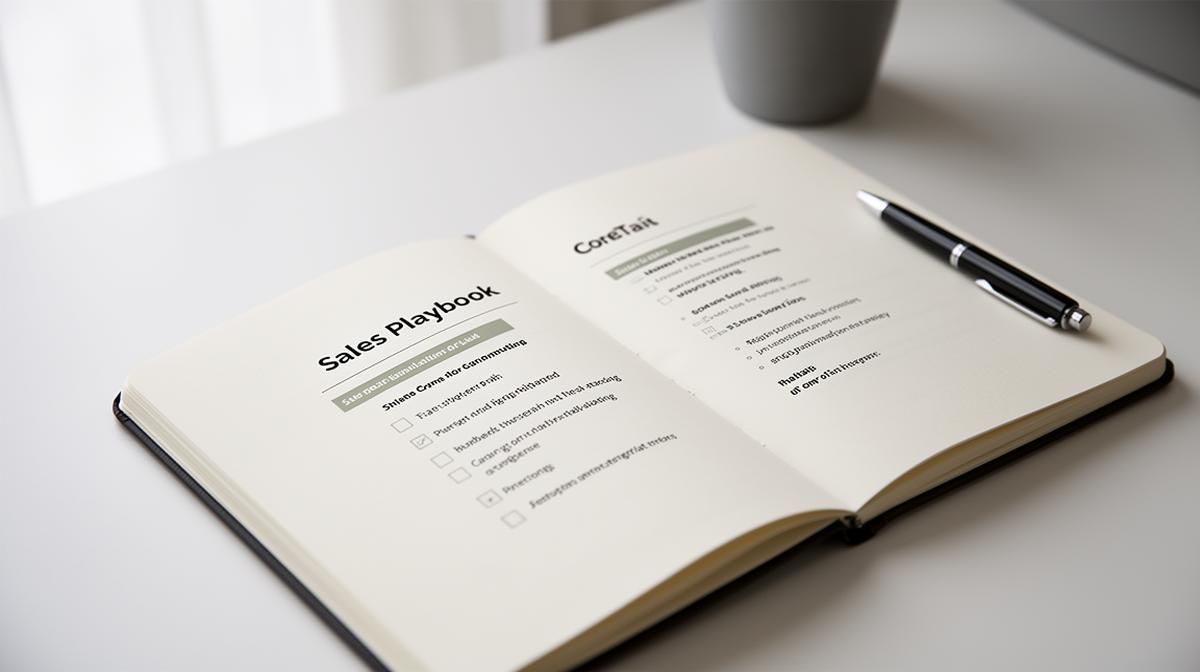
We've reviewed dozens of sales playbooks from IT and software companies. Most are 40-page documents that no one reads. They contain mission statements, product specs, and generic objection handling scripts that could apply to any company in any industry.
The playbooks that actually get used, the ones that change how reps behave on calls, look nothing like that.
Why Most Playbooks Fail
The typical sales playbook is created during a two-day offsite. The sales leader, a few reps, and maybe someone from marketing sit in a room and document everything they know about selling. The result is comprehensive, well-organized, and completely ignored within two weeks.
Here's why:
- It's too long. A 40-page document requires a significant time investment to read, let alone internalize. Reps are busy. They won't read it unless forced, and even then, they won't retain it.
- It's too generic. "Ask open-ended questions to understand the prospect's needs" is advice that applies to every sales role in every industry. It doesn't help a rep selling cloud migration services to mid-market manufacturing companies.
- It's static. The playbook reflects what the team knew at the time of creation. Markets change, competitors evolve, buyer behavior shifts. A playbook that doesn't evolve is a playbook that becomes irrelevant.
- It's disconnected from reality. The playbook describes how sales should work in theory. But it wasn't built from actual sales conversations, win/loss data, or buyer feedback. It was built from assumptions.
What a Useful Playbook Contains
A playbook that gets used contains five things, and ideally, not much more.
1. ICP Definition
Not demographics and firmographics. A real ICP definition answers: "What specific situation makes someone a buyer right now?"
For example, instead of "Mid-market companies with 100-500 employees in the technology sector," a useful ICP definition looks like: "IT services companies that have recently hired their first dedicated sales rep and are struggling to generate pipeline beyond the founder's network."
The first definition helps you build a list. The second helps you write a message that gets a reply.
A strong ICP definition includes:
- The trigger events that create buying urgency
- The specific pain points that your solution addresses better than alternatives
- The characteristics of companies where you've had the most success
- The anti-patterns, companies that look like good fits but consistently don't close
2. Opening Message Frameworks
Not templates. Frameworks. The difference matters.
A template is a fixed email that reps copy and paste. A framework is a structure that reps adapt to each prospect. Templates feel impersonal. Frameworks feel relevant.
A good opening message framework includes:
- The hook, a specific observation about the prospect's situation that shows you've done research
- The problem statement, a concise articulation of a challenge they're likely facing
- The proof point, a brief reference to a similar company you've helped
- The ask, a specific, low-friction next step
Each element should have 2-3 variations that reps can mix and match based on the prospect's context.
3. Discovery Question Map
Not a list of questions. A map. The difference is that a map shows the relationship between questions, what to ask first, what follow-up questions each answer triggers, and what the answers mean for deal qualification.
A discovery question map should include:
- Situation questions that establish the buyer's current state
- Impact questions that quantify the cost of the problem
- Timeline questions that establish urgency
- Decision questions that identify stakeholders and process
- Red flag indicators, answers that suggest the deal isn't worth pursuing
4. Qualification Criteria
Clear, binary criteria that separate prospects from suspects. Not subjective assessments like "seems interested" but objective criteria like "has confirmed budget allocated for this quarter" or "has identified a specific project sponsor."
Qualification criteria should include:
- Must-have criteria (deal-breakers if absent)
- Nice-to-have criteria (increase probability but aren't required)
- Disqualification criteria (signals that the deal won't close regardless of effort)
5. Next-Step Scripts
How to advance or exit a deal without ambiguity. For every stage of the sales process, the playbook should include:
- What a successful outcome looks like
- How to propose the next step
- What to do if the prospect hesitates
- How to gracefully disqualify if criteria aren't met
How to Build It
The best playbooks are built from data, not brainstorming sessions. Here's the process:
- Review your last 20 closed-won deals. What was the common thread? What questions did you ask? What messaging resonated?
- Review your last 20 closed-lost deals. Where did they stall? What objections weren't addressed? What was missing?
- Interview 5 recent buyers. Ask them what drove their decision, what almost stopped them, and what they wish you'd done differently.
- Draft the five sections based on what you learned, not what you assumed.
- Test it for 30 days. Have reps use it and track what works and what doesn't.
- Revise quarterly. A living playbook beats a perfect one.
The best playbooks are under 10 pages. They're built from real sales conversations, not marketing workshops. And they evolve quarterly based on what's actually working.
If your playbook doesn't change how reps behave on calls, it's not a playbook, it's a document.
Apply this thinking
See how ideas like these have played out in real engagements, or learn about how we build sales systems alongside your team. You can also meet the team behind Systemyx.
Sales Playbook Components Checklist
| status | priority | component |
|---|---|---|
| Must have before outreach | Critical | Ideal Customer Profile (ICP) |
| 2-3 detailed personas minimum | Critical | Buyer Personas |
| Problem-first, not feature-first | Critical | Value Proposition |
| Email + LinkedIn + Phone | High | Outreach Sequences |
| Question bank + qualifying criteria | High | Discovery Call Framework |
| Top 10 objections with responses | High | Objection Handling |
| Differentiation matrix | Medium | Competitive Positioning |
| 3+ with measurable outcomes | Medium | Case Studies |
| Clear packaging + negotiation guide | Medium | Pricing Framework |